Strategy, Marketing
There has been a host of articles in the news over the last couple of years about the number of things that millennials have killed. Most recently, according to Business Insider, they took deadly aim at Applebees and Buffalo Wild Wings.
Other things millennials have been accused of killing include, but are not limited to:
Let’s Get Real
Okay, listen, millennials didn’t kill any of these products or businesses. They killed themselves. Death by marketing suicide.
You must know your target market. You must research, identify and understand your ideal client, and then market to them. If you don’t, they aren’t going to buy your product, solicit your services, or engage your business. It’s that simple. And if you fail to do that, for goodness sake, don’t blame them.
Millennials aren’t really any different than any other generation that has come before them. You need to put the work into figuring out their wants, needs, and desires. You need to research their buying habits and their impulses.
(And….pssst….trade secret: your target market is constantly changing!) If you assume your target market is the same that it was ten years ago, you are probably missing out on some revenue opportunities.
Marketing isn’t Static
 That’s why marketing is a constant evolving machine. You should create new marketing plans each and every year and regularly evaluate the return on your investment. Data can drive your decisions and that includes researching your target audience often.
Your target market is spending its hard-earned dollars on something – don’t let your competition figure out how to earn their attention before you do.
Branding, Marketing, Social Media, Strategy

Looking back on what people thought 2017 might look like 100 years ago, most people probably imagined flying cars or teleportation. I think it’s safe to say that didn’t happen. Instead, we reinvented something even more amazing: rompers for men.
Yes. You read that right.
 For those of you who have never heard the word “romper” before, a romper is a one-piece garment that looks similar to a dress but has shorts below the waste instead of a skirt. They are as convenient as they are fashionable, a true American treasure.
The newest clothing line called RompHim, by ACED Design, was launched last week as a Kickstarter campaign. The four male founders set a goal of raising $10,000. Clearly, they underestimated the demand for chic male onesies, because they surpassed their goal by over $355,000. Not too bad for still having 21 days left in the campaign. Bravo, gentlemen.
Been there, done that.
The Kickstarter pledging process is simple, but unique. Unlike the old school, magazine-ordered bodysuits, RompHim customers can choose their price. Starting at $5 and capping off at $1,250, the company offers anything from online updates, to the opportunity to hand select your own RompHim fabric. Your $1,250 pledge also buys you a night on the town with the ACED Design team, making your evening as unique as the onesie you rode in wearing.


Tweet about it.
Twitter seems to be the social media platform of choice for both praise and disapproval, resulting in several millions of #RompHim tweets. Whether people see it as a fashion statement or a frat-inspired gag gift, it doesn’t matter. Either way, the tweets and memes are considered “the best thing on Twitter”, and I have to agree.

Two thumbs up!
So where does that leave me? Besides paying $1,250 to go on a bro-date with the founders, I think RompHims are fantastic. Anything that can make me laugh out loud and still look that good has my vote. Also, I’m quite pleased that men will finally understand the struggle of having to completely undress to use the restroom.
As for the next 100 years, I can only hope that men will still be coming up with ways to masculinize products that were originally designed for women. That said, I’m all for gender equality, but some things are better off unaltered. They can have their Mandles, Brogurt, and RompHims, but I’d like to keep my high heels and over-priced handbags.
Strategy, Communication, Marketing, Public Relations, Social Media
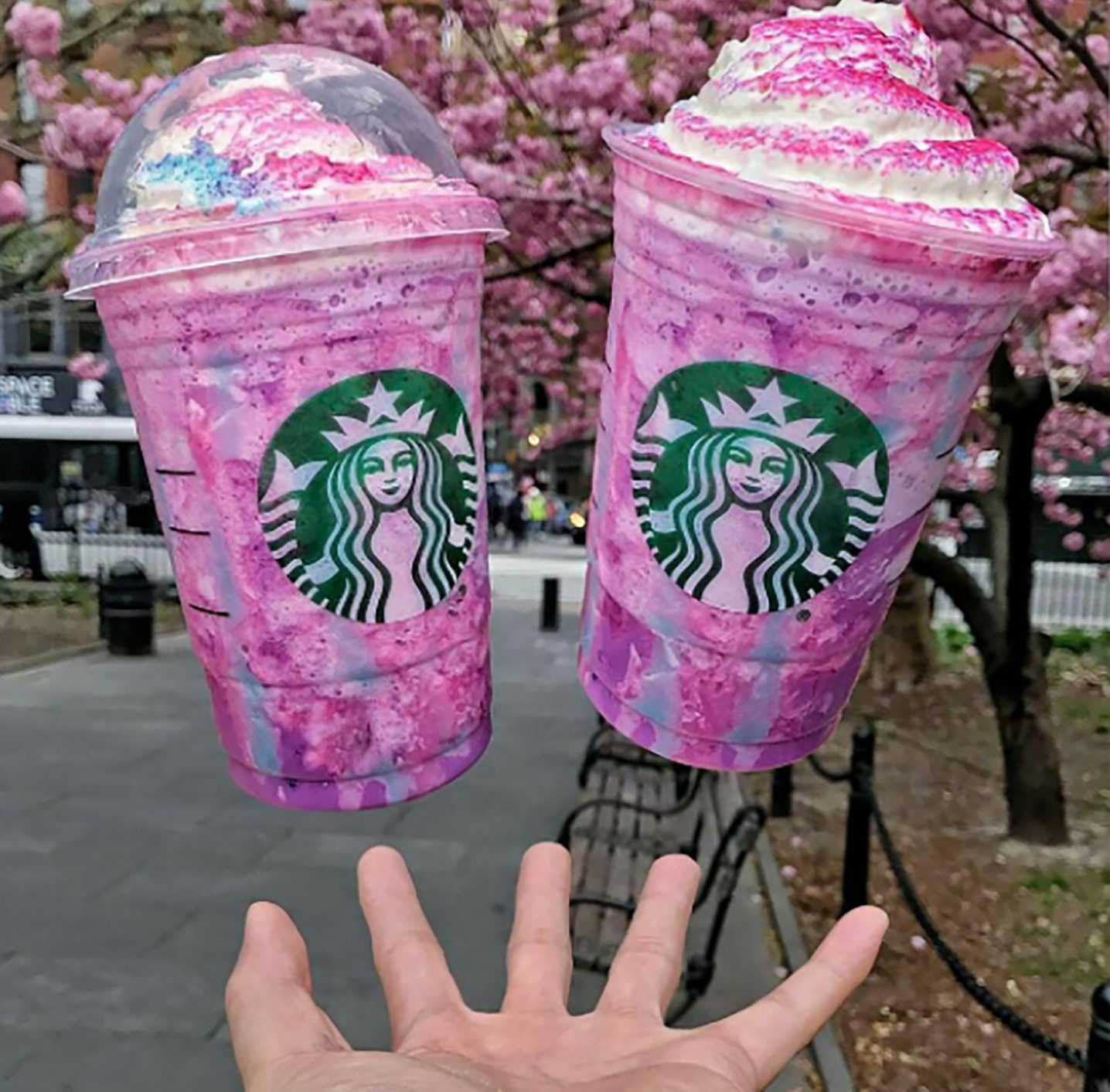
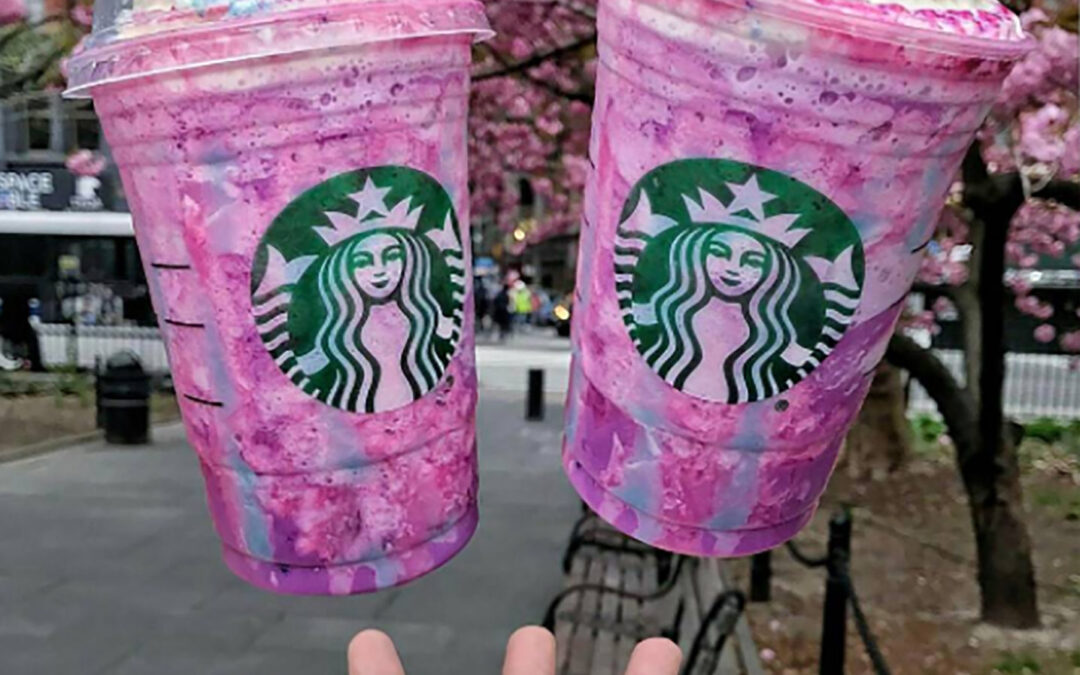
The age of posting excessive pictures of your fancy drinks and fun foods on social media has arrived. Since the dawn of social media, people have captured photos and posted them online for the world to see. But now, everywhere you turn someone is seeking the perfect lighting for a picture of the newest vegan soup, or for the case of this discussion, the newest Starbucks drink.
But I love Starbucks…
There is no denying that Starbucks is dominating the Café industry, but have they gone too far? The new Unicorn Frappuccino went from an internet sensation to a controversial lawsuit in a matter of weeks. The globally desired drink hit the shelves on April 19 and was said to be a limited time offer. Limited time offer…brilliant. Not only did they develop a drink that was social media gold, they scheduled it so that everyone would have to try it before it was too late. Even the customers who were unable to get their hands on one turned to social media. Only this time to vent their frustration. I guess it’s true what they say, there’s no such thing as bad publicity!
 PR specialists explain that the Unicorn Frappuccino was inspired by unicorn-themed food and drinks trending on social media, unicorn emojis, and the unicorn filter on Snapchat. Brooklyn café, The End, had a different opinion, saying that Starbucks ripped-off their already established drink called the Unicorn Latte. The End began selling the Unicorn Latte in December of 2016, and has had a pending trademark for the drink name since January of 2017. That said, The End isn’t the only small business with a unicorn-inspired drink on their menu. This mythical creature is truly taking the social media world by storm #magic.
The interesting thing about these trends is that companies often leave the marketing up to the consumers. Why dump millions of dollars on social media campaigns when your customers will go online and do it for you? Aside from the initial announcement of the new product, companies get to sit back and watch as we upload endless posts, making their product a desirable fixation.
Take away the sparkles and what are you left with?
As a millennial, I too have developed a love for social media. I’ll even share the occasional photo of decadent cocktails or colorful cuisine that I come across. The one thing I don’t understand is the obsession over these trends, especially when people don’t actually enjoy the product. Most folks who purchased the Unicorn Frappuccino said they didn’t like the taste, claiming it tasted like sour milk.
There’s nothing magical about sour milk. I don’t care how sparkly or mystical it looks, if it tastes like dairy-gone-bad we should be tagging it the #DirtyDonkeyFrappe.
Strategy, Marketing
Does your business have a marketing plan?
Come on, be honest. It’s okay if you answer no. I think you’d find yourself in good company. According to latest survey done by Manta, less than half of all small business owners have a marketing plan. Why? Well, I’m sure you know the answer to that one as well. Small business owners are overloaded with work and stretched too thin to dedicate either time or resources to creating a marketing plan.
But you should. A marketing plan should be a part of your greater business plan (complete with an operating budget) and should be updated often, or at the very least annually.
Let me tell you why.
 Have you ever gone to Disney World? If so, you know that a good trip requires good planning. Whether you hire a professional (like a travel agency or a travel planner) or you plan it yourself, it’s a significant time investment.
You make your resort and travel reservations almost a year in advance. Six months ahead, you make your dining reservations (and you do so quickly as the hot venues fill up fast). You plan which days you are going to visit which parks, taking in account the extra magic hours, parades, and fireworks.
If you don’t plan for your trip, could you still go to the most magical place on earth? Of course you could. But that trip would be expensive. Without planning ahead and reserving your accommodations and travel arrangements in advance, costs could be almost three times as much as if you had planned effectively. You wouldn’t be able to eat at the dining locations of your choosing – those venues fill up with reservations very quickly. You wouldn’t be able to get tickets to special shows and events. You may go to the wrong park on the wrong day and miss something special (like a parade or fireworks).
Would you still have an enjoyable time? Probably. It is Disney World, after all. But you would be throwing money out of the window, based on necessity and emergent situations and wouldn’t be getting the most out of your trip.
The same is true about creating a marketing plan.
Yes, it takes a lot of time and effort to make it happen. Sometime, you need to bring in the professionals. But the planning pays off. You are going to spend less, do more, and get the most return out of that investment. And that? That is magical.
Communication, Marketing, Public Relations
United Airlines issued a report last week outlining changes in policy to prevent another incident like the one that occurred in April. After violently removing a passenger from one of their flights, their response to the situation was less than ideal.
“I breached public trust with this event and how we responded,” Munoz told The Associated Press. “People are upset, and I suspect that there are a lot of people potentially thinking of not flying us.”
United Airlines is finally admitting they didn’t respond effectively to the situation. Earlier, I talked about what this incident can teach us about public relations.
 I can’t stop thinking about this situation, though. I want to know why it happened. How it happened.
Between United Airlines and the Kendell Jenner Pepsi Ad, there have been some high profile mishaps in the marketing universe. Pepsi created an ad intending to show they were cutting edge, on the edge of social change. As soon it aired, public outcry demanded it be removed. It was seen as racist, elitist, and everything that is wrong with our society.
I don’t think I’m alone in wondering how they got there. How did the in-house Pepsi team sit in a room and approve that ad? Why did it take United Airlines so very long to realize the error of their ways?
I Have a Theory
 Have you ever heard of groupthink? First defined in 1972 by Irving Janis, this communication theory illustrates when a group comes to a unanimous wrong decision despite facts that point to a different outcome. Basically, the group cares more about group cohesiveness, approval, and everyone feeling “good” about the decision and being “right”. Options get overlooked, opinions are left unsaid, and critiques are withheld. This often leads to terrible results – some famous examples include the Challenger disaster and the Bay of Pigs invasion.
I believe groupthink played a large role in both United Airlines and Pepsi’s decision making.
It makes you wonder – are you guilty of groupthink in your organization? What about tunnel vision or having a myopic outlook? All things that work together to create a perfect storm of bad decision making.
Groupthink Quiz
Here’s a quick quiz to help you determine if you are guilty of groupthink – answer yes to one of these questions and maybe it’s time to put some preventive measures in place.
- Are people in your organization afraid to offer an alternative opinion that goes against the majority? How do you know that they are not? Do you have anonymous survey data to back that up?

- Do most of your meetings seem very harmonious with absolutely no discussion or disagreement? There can sometimes be too much of a good thing.
- Do you avoid bringing in an outside opinion or perspective? When’s the last time that happened?
- Does the leader of your organization give their opinion before everyone has chimed in?
- Do you assume silence by any member means they agree with the majority?
Why It Matters
In the case of United Airlines and Pepsi, the outcome of their bad decision making has been quite devastating. They are now dealing with the following:
- Dramatic drop of stock prices immediately following the incidents
- Negative publicity
- Demolition of their company image
- Legal ramifications
- Potential loss of future revenue
To grow as an organization, it’s important to take constant stock on both your internal and external communication strategies. Sometimes, that adjustment is a slight pivot, and other times it requires a giant leap in a different direction.
Groupthink has led to some terrible outcomes for companies and consumers. Don’t be the next example of what not to do.

Communication, Marketing, Strategy
 Most people can agree that reading statistics and data-dense content can be very boring. Without any visual appeal, the average person will most likely forget the data they’ve read shortly after reading it. The good news is that there is an effective alternative to presenting data that aids in understanding and retaining the information provided: infographics.
An infographic is a popular form of content marketing that can help you simplify a complex topic. Ideally, an infographic should be visually attractive and contain subject matter and data that is interesting to your target audience. Doesn’t that sound more enticing than reading textual statistics and endless data? We thought so too.
Infographics show your products without actually telling people about them. That, in turn, allows viewers to make their own decisions about your product. Visuals allow your brain to make connections more easily: information is expressed quickly and concisely which breaks through the clutter of other content.
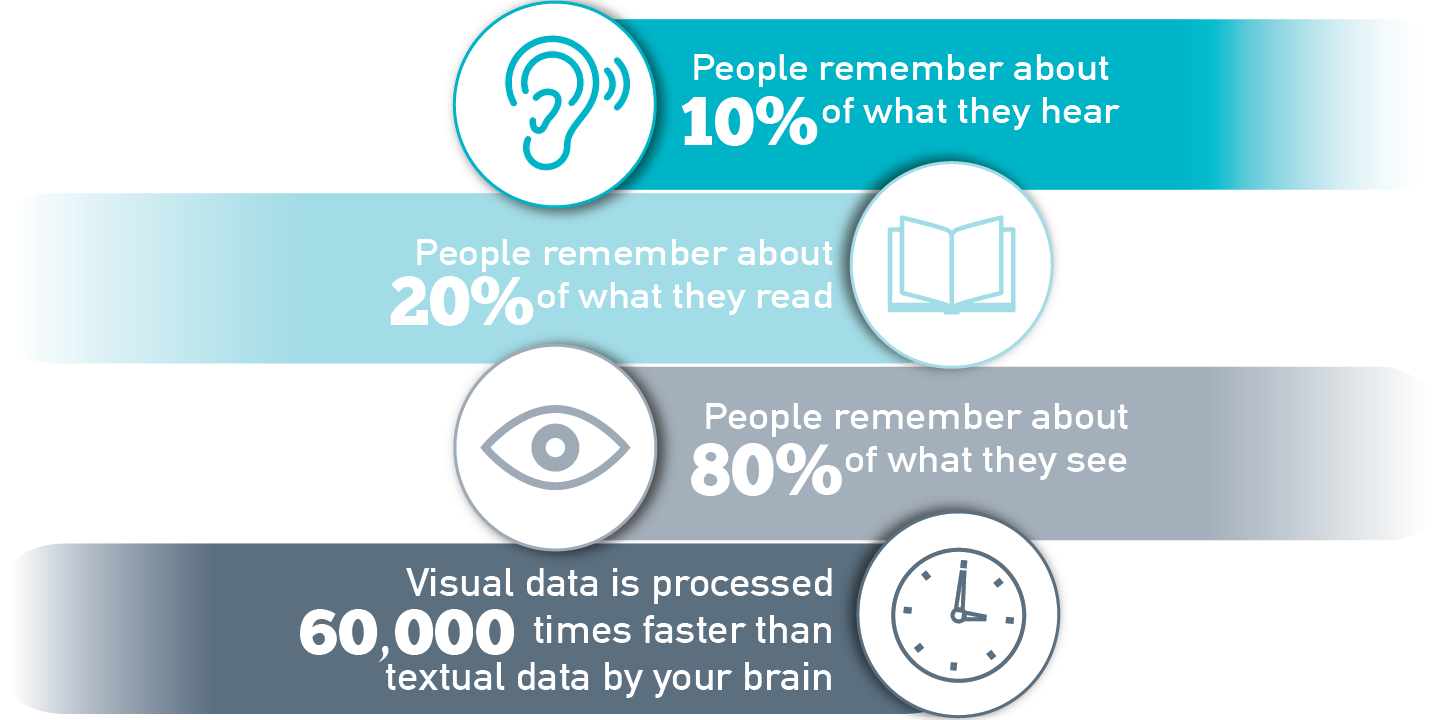
So how do infographics actually help your company’s marketing strategy? Quite simply, creating infographics allows for your target audience to become more involved in your data and ultimately increase your brand awareness. When it comes time to design your visual keep the following tips in mind:
1. ENSURE CONSISTENCY AND EFFICACY
- Don’t repeat things—this just adds to the clutter
2. NARROW YOUR NARRATIVE
- Make sense of the data by telling a story
- With complex topics, it makes sense to paint with broad strokes first and then narrow down to the nitty gritty details
3. CHOOSE A VISUAL APPROACH
- Literal representation of data (charts, graphs, typography)
- Metaphorical representation of data (illustrations)
- Hybrid of both literal and metaphorical representations
- Use what is consistent with your brand!
Content marketing is a major source of social sharing, and is considered one of the most cost effective ways of generating multipart website growth. With your visual content being as attractive as it is informational, your content marketing strategy will improve, increasing online traffic and overall consumer involvement.